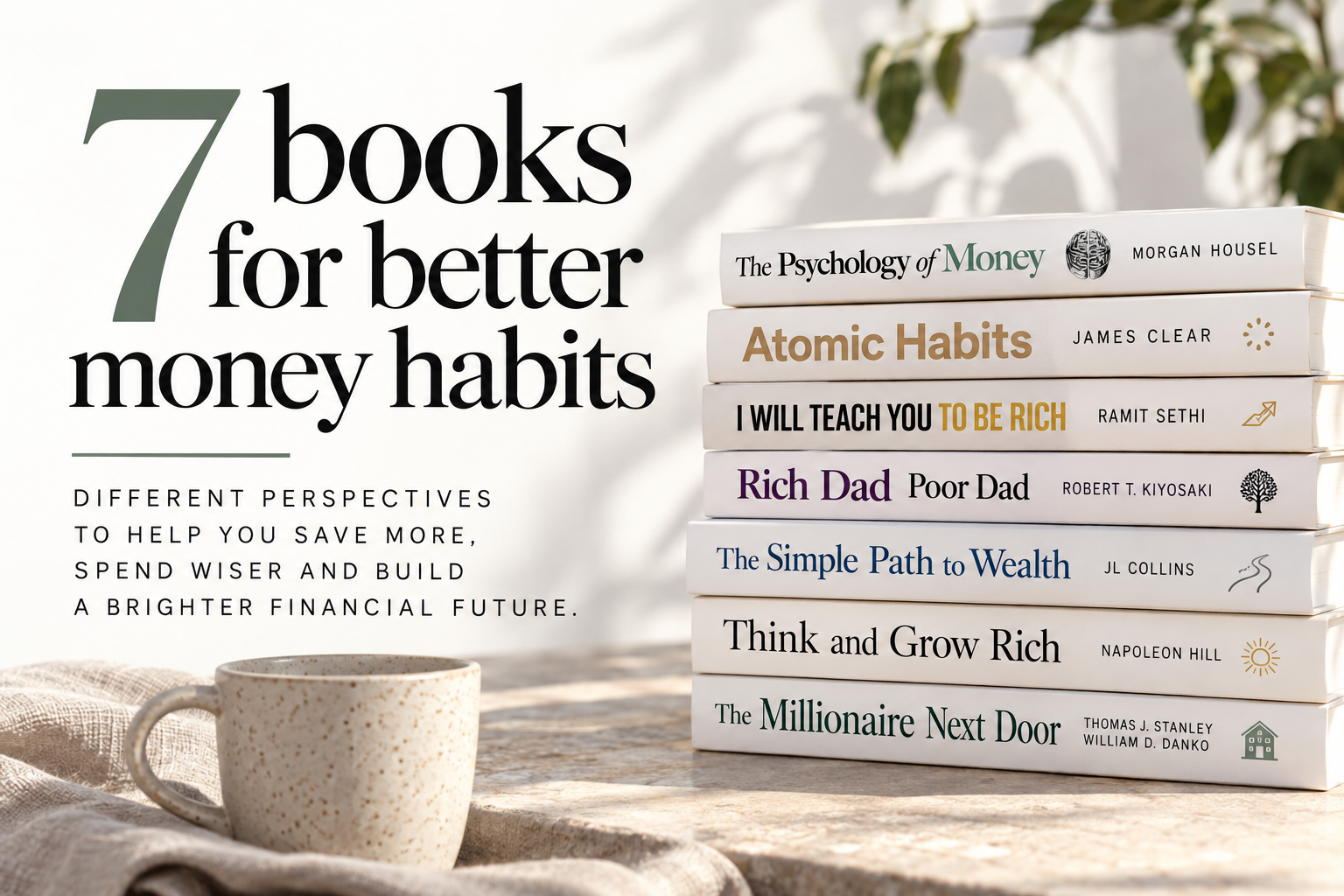
Building a better financial future isn’t necessarily about earning more. Sometimes, it starts with changing how you think about money.
Your spending habits, financial decisions, and understanding of wealth can have a significant impact on your long-term financial well-being. But with so much conflicting advice available, knowing where to start isn’t always easy.
These seven books offer different perspectives on personal finance, from understanding the psychology behind your spending decisions to developing better habits and learning the fundamentals of investing.
Whether you’re trying to save more, get your finances organized, or work toward financial independence, there’s something here for you.
Disclosure: As an Amazon Associate, I earn from qualifying purchases. This article contains affiliate links, which may earn me a commission at no additional cost to you.
1. The Psychology of Money — Morgan Housel
Best for: Understanding your relationship with money.
Why do people with similar incomes sometimes end up in completely different financial situations?
Morgan Housel explores how emotions, personal experiences, and individual attitudes influence financial decisions. Through engaging stories, he explains why managing money successfully often has more to do with behavior than technical knowledge.
What you’ll learn:
- Why financial success depends on behavior, not just knowledge.
- How your personal experiences influence your financial decisions.
- Why managing risk and expectations matters.
- The difference between building wealth and keeping it.
One practical takeaway: Before making a major financial decision, consider whether you’re responding to your actual needs or comparing yourself to someone else’s financial situation.
Read this if: You want to understand why you make certain financial decisions and develop a healthier relationship with money.
2. Atomic Habits — James Clear
Best for: Building financial habits that actually stick.
Although Atomic Habits isn’t exclusively about personal finance, its principles can transform the way you manage money.
James Clear explains how small, consistent improvements can produce significant results over time. Instead of relying on motivation or attempting dramatic lifestyle changes, he encourages readers to create systems that make good habits easier to maintain.
Three ways to apply its principles to your finances:
- Set up an automatic savings transfer every payday.
- Introduce a 24-hour waiting period before making nonessential purchases.
- Review your spending for five minutes every evening.
One practical takeaway: Choose one financial habit and connect it to something you already do every day.
Read this if: You regularly set financial goals but struggle to maintain the habits needed to achieve them.
3. I Will Teach You to Be Rich — Ramit Sethi
Best for: Creating a practical financial system without giving up everything you enjoy.
Ramit Sethi takes a refreshing approach to personal finance. Instead of focusing exclusively on cutting expenses, he encourages readers to identify what matters most to them and spend intentionally.
The book offers practical guidance on organizing finances, automating payments, saving, and investing.
What you’ll learn:
- How to automate your financial responsibilities.
- Why conscious spending can be more effective than extreme restriction.
- How to approach saving and investing systematically.
- How to define what a rich life means to you.
One practical takeaway: Identify three expenses that genuinely improve your quality of life and three that don’t. Consider redirecting money from the latter toward your financial priorities.
Read this if: You want a structured financial plan without feeling deprived.
Note: Some recommendations are specific to the US financial system.
4. Rich Dad Poor Dad — Robert T. Kiyosaki
Best for: Exploring alternative perspectives on wealth and financial education.
Rich Dad Poor Dad challenges conventional assumptions about earning money, employment, and wealth creation.
Through contrasting financial philosophies, Kiyosaki encourages readers to reconsider the relationship between income, assets, and financial independence.
What you’ll explore:
- Different approaches to earning and managing money.
- The distinction between income and accumulated wealth.
- The importance of financial education.
- Why developing assets can matter for long-term financial goals.
One practical takeaway: Calculate your current net worth by subtracting your liabilities from your assets. Repeat the exercise periodically to track your financial position.
Read this if: You’re interested in exploring different approaches to building wealth and questioning conventional financial assumptions.
Note: Some of the book’s financial definitions and recommendations are debated. Consider it an introduction to financial perspectives rather than a technical investment guide.
5. The Simple Path to Wealth — JL Collins
Best for: Understanding long-term investing without unnecessary complexity.
Investing can feel overwhelming when you’re confronted with endless financial products, complicated terminology, and conflicting recommendations.
JL Collins presents a straightforward investment philosophy built around simplicity, low costs, and a long-term perspective.
What you’ll learn:
- How index funds work.
- Why investment fees matter.
- The importance of long-term thinking.
- How investing can support financial independence.
One practical takeaway: Before choosing an investment fund, examine its fees. Even relatively small differences in annual costs can have a meaningful impact over long investment periods.
Read this if: You want to understand the fundamentals of long-term investing.
Note: The book primarily discusses US investment accounts and markets. Investing involves risk, and individual circumstances matter.
6. Think and Grow Rich — Napoleon Hill
Best for: Exploring motivation, persistence, and goal-setting.
Originally published in 1937, Think and Grow Rich examines the attitudes and behaviors Napoleon Hill associated with personal achievement.
Unlike the other financial books on this list, it focuses primarily on motivation, ambition, and developing a goal-oriented mindset.
What you’ll explore:
- The importance of setting clear goals.
- How persistence can support long-term projects.
- The relationship between planning and achievement.
- Why consistent action matters.
One practical takeaway: Write down one specific financial goal, identify the actions required to achieve it, and establish a realistic timeframe.
Read this if: You’re interested in the motivational aspects of pursuing financial and personal goals.
Note: This is a historical self-development classic, not an evidence-based financial or investment manual.
7. The Millionaire Next Door — Thomas J. Stanley and William D. Danko
Best for: Understanding the difference between looking wealthy and actually building wealth.
What if the people who appear wealthy aren’t necessarily the ones with the greatest financial security?
Based on research into American millionaires, The Millionaire Next Door explores the relationship between income, spending habits, and accumulated wealth.
The book challenges the assumption that expensive possessions and visible luxury are reliable indicators of financial success.
What you’ll learn:
- The difference between income and net worth.
- How spending habits influence wealth accumulation.
- Why lifestyle inflation can undermine financial progress.
- How financial independence differs from outward appearances.
One practical takeaway: When your income increases, consider directing part of that increase toward savings or investments before expanding your lifestyle.
Read this if: You want to rethink your spending habits and develop a more intentional approach to building wealth.
Note: The book’s research reflects particular historical and economic circumstances in the United States.
Which Personal Finance Book Should You Read First?
You don’t need to read all seven books to start making progress. Choose the one that addresses your most immediate challenge.
| Your financial goal | Start with |
|---|---|
| Understand your financial behavior | The Psychology of Money |
| Build consistent habits | Atomic Habits |
| Organize your finances | I Will Teach You to Be Rich |
| Explore different perspectives on wealth | Rich Dad Poor Dad |
| Understand long-term investing | The Simple Path to Wealth |
| Improve motivation and goal-setting | Think and Grow Rich |
| Rethink spending and wealth | The Millionaire Next Door |
Final Thoughts
Improving your finances doesn’t require changing everything overnight.
Start with one book and identify one practical idea you can apply to your own circumstances.
Whether that means automating your savings, reconsidering unnecessary purchases, or learning more about investing, small and consistent decisions can contribute to meaningful long-term progress.
The goal isn’t simply to accumulate more money. It’s to create greater financial security and the freedom to make choices that reflect your priorities.
Leave a Reply